What They Develop
- Problem-solving skills
- Planning and sequencing
- Hand-eye coordination
- Focus and patience
- Spatial awareness
- Trial-and-error thinking
Explore kids toys, games, and activities with more clarity.
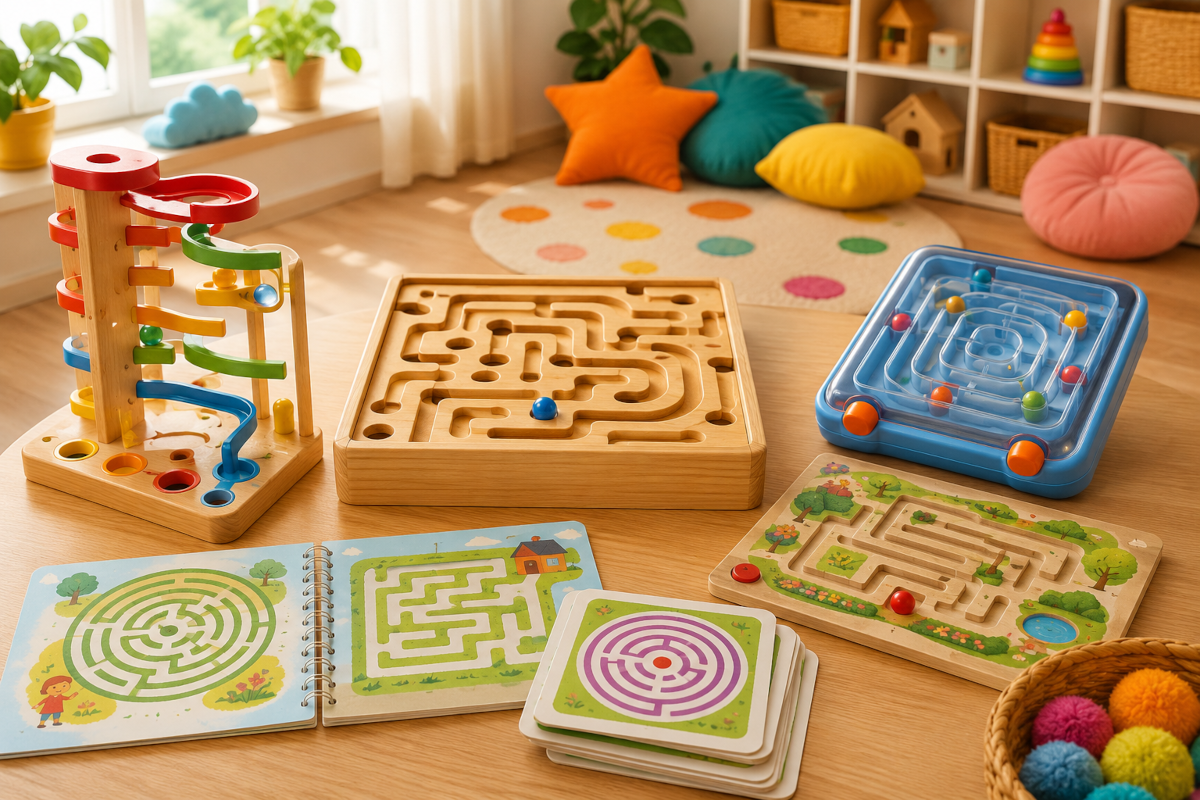
Maze and labyrinth games challenge kids to guide a marble, token, pencil, or path through twists, turns, dead ends, and planned routes. They encourage children to slow down, look ahead, adjust their choices, and keep trying until they find a working path.
This group includes marble mazes, labyrinth boards, path-finding puzzles, handheld maze games, and maze books. They work well for children who enjoy visual challenges, steady-hand activities, quiet problem-solving, and screen-free puzzles that can be played alone or with family nearby.
Always follow the age rating on the maze game. Marble mazes and handheld puzzles may include small balls, magnets, loose pieces, or parts that can be a choking hazard for younger children. Choose large-piece versions for younger kids and store small parts safely.
Typically 4+ years for simple large-piece maze boards and maze books, and 6+ years for marble mazes, handheld maze games, and more complex path-finding puzzles, depending on small parts and difficulty.
Single-player maze solving, quiet focus time, steady-hand challenges, travel puzzles, classroom activities, family puzzle challenges, and screen-free path-planning play.